Most people check their Google rankings the slow way. They open an incognito window, type in a keyword, scroll, and try to spot their site somewhere in the list. Then they do it again next week and try to remember whether they moved.
That approach is unreliable (your own search history skews the results) and it doesn’t scale past a handful of keywords. Daily rank tracking fixes both problems, and setting it up takes about five minutes. Here’s the whole process.
Why daily, and not “whenever I remember”
Rankings move constantly. Google updates its index throughout the day, competitors publish new pages, and the search results themselves get reshuffled. If you only check now and then, you see snapshots with no story connecting them. You notice you dropped, but not when, and not what else changed at the same time.
Daily tracking turns those snapshots into a line. When a page slips from position 4 to 9, you want to know it happened on Tuesday, not discover it three weeks later when traffic is already down. The point isn’t to stare at the numbers every morning. It’s to have a record so that when something moves, you can see exactly when it started and work backward to why.
You can’t fix a ranking drop you didn’t notice. Daily tracking is mostly about catching the moment things change.
The five-minute setup
Every rank tracker works a little differently, but the core flow is the same. Here’s how it goes in RankChecker.
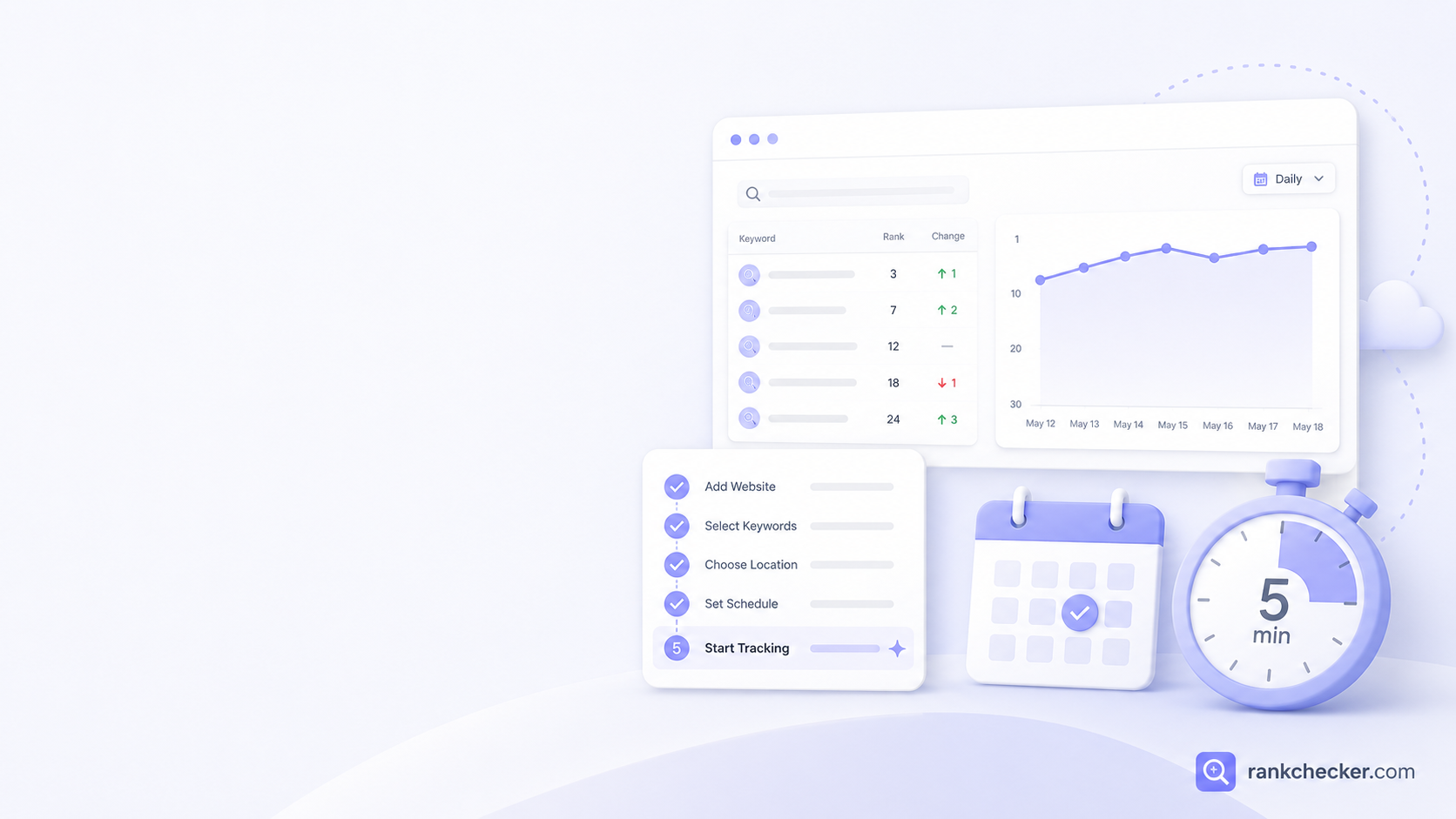
1. Add your domain. Type in the site you want to track. This is the domain the tracker looks for in the results. If you rank under both the root domain and a subdomain, add the version that matches how your pages actually appear in Google.
2. Add the keywords that matter. Resist the urge to add hundreds. Start with the ten or twenty searches you most want to win, the ones tied to real revenue or sign-ups. You can always add more later. A focused list is easier to read and tells you more than a giant one you never look at.
3. Set location and device. Rankings differ by where the searcher is and what they’re searching on. A plumber in Toronto cares about Toronto results, not national ones. Pick the location your customers actually search from, and choose desktop, mobile, or both. Mobile and desktop results often differ, so if most of your traffic is mobile, track that.
4. Turn on AI Overview tracking. This is the step most trackers skip, and it’s the one that matters most in 2026. Google now places an AI-generated answer above the blue links on many searches, and that answer cites its own sources. You want to know two things: whether an AI Overview appears for your keyword at all, and whether it cites you. Flip this on so each keyword reports its AI Overview status alongside the classic position.
5. Save and let it run. That’s it. The tracker takes its first reading and then checks again on a daily schedule. You don’t need to do anything else.
What you’ll see tomorrow
The first run gives you a baseline: where each keyword sits today. The value builds from there. After a few days you’ll have a short trend line per keyword, and after a few weeks you’ll see the real shape, which terms are climbing, which are sliding, and which sit still.
For each keyword you’ll be able to see your classic position, whether an AI Overview is present, and whether your site is one of the sources it cites. That last column is the one to watch. You can hold position 3 in the blue links and still lose the click if the AI answer above you pulls from a competitor instead. Tracking both numbers side by side is the only way to see that happening.
How often to actually look
Set it to run daily, but you don’t need to read it daily. A quick scan once or twice a week is plenty for most sites. Check more often right after you publish or change an important page, since that’s when movement is likely, and after a known Google update, when the whole results page can shift.
The mistake to avoid is reacting to a single day. Rankings wobble a point or two naturally, and chasing that noise leads to changes you’ll regret. Wait for a trend, three or four days pointing the same direction, before you treat a move as real.
That’s the whole thing
Five steps, five minutes, and you trade guesswork for a record. From tomorrow morning you’ll know where you stand on the searches you care about, classic rankings and AI Overview presence together, updated every day without you lifting a finger.
If you want to set it up right now, you can add your first keywords in the time it took to read this.